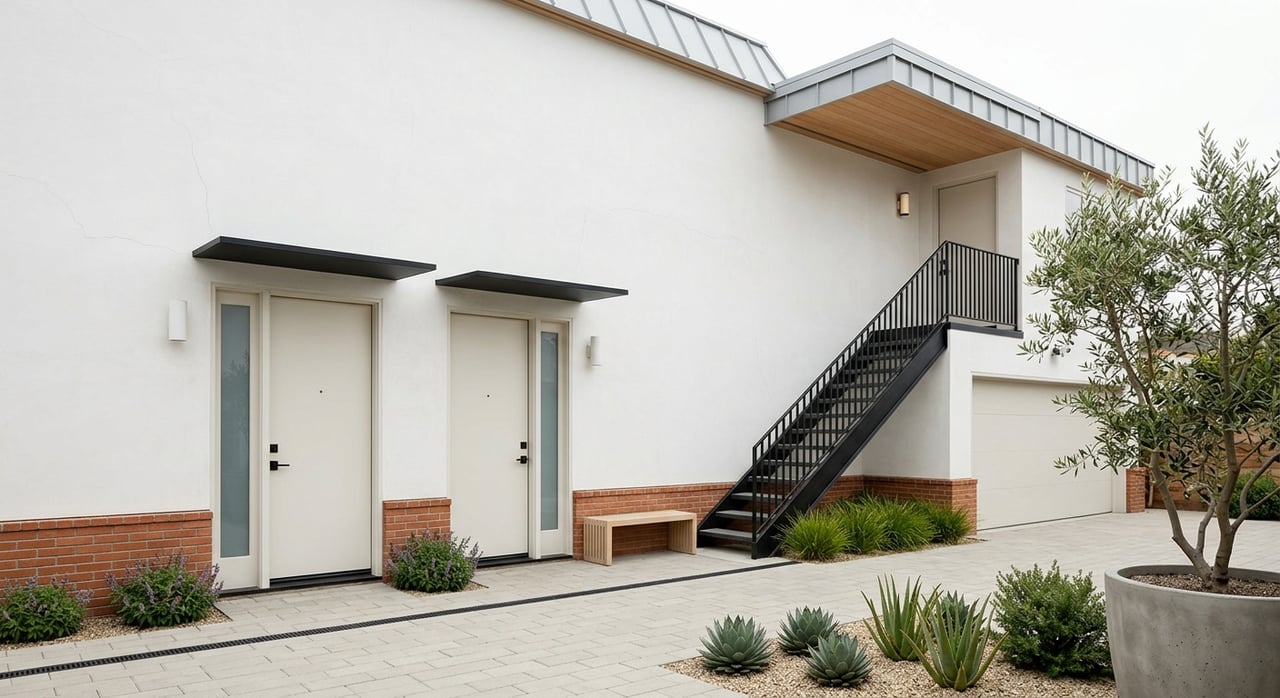
Oceanside ADU and Duplex Guide for Smart House Hacking
April 2, 2026
April 2, 2026
If you want to lower your housing costs while building long-term value, house hacking in Oceanside can be a smart path, but only if you start with the rules. In this market, the opportunity is real for buyers looking at ADUs, duplexes, or small multifamily properties, yet the details around zoning, permits, and rental use matter more than social media shortcuts. This guide will help you understand where house hacking may work in Oceanside, what to verify before you buy, and how to think about the strategy for the long run. Let’s dive in.
Oceanside has several demand signals that support a patient, long-term house-hacking strategy. According to HUD’s 2024 housing market analysis for the region, active-duty personnel at Camp Pendleton mainly rent in Oceanside, and about two-thirds of military personnel are renters. That matters because steady rental demand can support owners who plan to live in one unit and rent another.
The same HUD report estimated Oceanside’s apartment vacancy rate at 4.5% in Q2 2024, with average rent at $2,283. Countywide, the San Diego County Apartment Association survey cited in the research showed 3.6% vacancy and 4.1% year-over-year rent growth in spring 2025. Those numbers are snapshots, not guarantees, but they do suggest Oceanside is better suited to stable, 31-plus-day rental income than a quick speculation play.
The city also needs more housing. Oceanside’s planning goals include 5,443 new units in the 2021 to 2029 cycle, which adds context for why ADUs and smaller infill housing continue to matter locally. At the state level, California HCD describes ADUs and JADUs as flexible housing options that can create additional income for homeowners, but the exact path always depends on current local rules.
In Oceanside, house hacking is not one single property type. It can mean buying a detached home with room for an ADU, purchasing a duplex and living in one side, or targeting a small multifamily property where one unit becomes your home base and the others help offset expenses.
That flexibility matters because Oceanside’s housing stock is still mostly low-density. City planning materials based on 2016 to 2020 ACS data show a mix of 56% detached homes, 13% attached homes, 1% 2 to 4 unit properties, 16% 5 to 19 unit properties, 9% 20+ unit properties, and 5% mobile home or other. In plain terms, your search may start with single-family homes, but there are still real multifamily pockets worth watching.
The city notes that larger shares of multifamily housing are located north of Mission Boulevard and west of Ron Ortega Recreation Park, based on its planning materials. That does not make those areas universally better or worse for every buyer, but it does support a targeted search if your goal is to find existing duplex, triplex, or fourplex inventory.
In Oceanside, zoning should shape your strategy before you get attached to a property. The city’s zoning code distinguishes between single-unit, two-unit, multi-plex, and multiple-unit structures, and the district often determines what is realistic.
In the RS district, existing duplexes, triplexes, and fourplexes may remain, but new construction is generally limited to single-family dwellings or approved accessory structures. In RM districts, duplexes, townhouses, and multi-dwelling structures are explicitly allowed, while RH and RT districts are intended for higher-density residential uses.
For you as a buyer, that means two listings with similar square footage can have very different long-term potential. One may support an ADU-based strategy, while another may be better suited to a true multi-unit setup. The best house-hacking opportunities in Oceanside usually begin with a clear read on the parcel, not just the floor plan.
If you are looking at a detached home, Oceanside’s local ADU rules are essential. The city’s ADU planning page and adopted standards make it clear that ADUs and JADUs can be a strong path for adding legal housing, but you need to verify the current standards for the specific site.
On a single-family parcel, Oceanside allows one ADU or JADU, and a JADU may be located within the primary dwelling or an accessory structure. In some cases, a JADU and an ADU can be combined, which can create more flexibility for owners trying to balance privacy, layout, and rental goals.
Size rules also matter. Under the city’s adopted standards, detached ADUs can generally be up to 1,200 square feet, while attached ADUs cannot exceed 50% of the primary dwelling’s living area. The city also recognizes a statewide exemption path for smaller ADUs with 4-foot side and rear setbacks, which can be helpful on tighter lots.
Permitting is designed to be more straightforward than many buyers expect. Oceanside states that ADU and JADU permits are reviewed ministerially and that the city must act within 60 days after receiving a complete application. If the property is in the coastal zone, the ADU still must comply with the Local Coastal Program, but the city says no public hearing is required.
House hacking is not limited to single-family homes. On existing multifamily properties, Oceanside allows at least one ADU or up to 25% of the existing unit count in non-livable space. The city also allows up to two detached ADUs up to 850 square feet each, or 1,000 square feet if the unit has more than one bedroom, subject to 16-foot height and 4-foot side and rear setbacks.
That can open the door for buyers considering a duplex, triplex, or fourplex as a long-term hold. If you find a property with underused garage, storage, or other non-livable space, the value may be in what can be added legally over time, not just what exists today.
This is also where lender classification becomes important. A property may be financed differently depending on whether it is treated as single-family, 2-unit, or 3 to 4 unit housing. Before you make an offer, it is worth understanding how the lender sees the asset, because that affects down payment expectations, reserves, and monthly cost.
A good house-hack deal is not just about potential rent. It is also about what it costs to create or legalize that income stream.
Oceanside’s ADU standards offer some helpful economics. The city says it does not impose ADU impact fees, and no replacement parking is required when a garage, carport, or covered parking structure is converted with the ADU. Several parking exemptions can also apply, including for properties near transit and for internal conversions.
That said, not every ADU path costs the same. The city notes that detached new construction can face higher permit-fee treatment than conversion projects. If you are comparing two homes, one with an easy interior or garage conversion and another needing a full detached build, your timeline and cash needs may look very different.
One of the biggest mistakes buyers make is assuming an ADU can operate like a vacation rental. In Oceanside, that assumption can quickly unravel the numbers.
The city states that ADUs and JADUs must be rented for more than 30 days. It also says that properties with an ADU or JADU permitted on or after September 9, 2017 cannot use the ADU, JADU, or primary residence as a short-term rental. If your plan depends on Airbnb-style income, you need to stop and rework the strategy.
For most buyers, the stronger approach is simpler anyway. Oceanside makes more sense as a long-term, rules-based income strategy built around a legal ADU, JADU, duplex, or small multifamily property with 31-plus-day rentals.
Some buyers also ask about SB 9. In Oceanside, the city’s SB 9 guidance explains that eligible single-family-zoned parcels may allow two-unit development or an urban lot split, but SB 9 is not a shortcut around every local rule.
The city specifically notes that ADUs and JADUs are prohibited in conjunction with a lot split under this path. It also highlights occupancy, parking, and coastal-zone constraints that can affect feasibility. In other words, SB 9 may help in select cases, but it should be evaluated carefully and not treated as a blanket solution.
If you are serious about house hacking in Oceanside, these are the practical questions that matter most:
These questions can save you from buying based on a concept instead of a workable plan. Oceanside’s own materials also note that private HOA CC&Rs may add restrictions, and the city does not enforce those private rules. That makes your pre-purchase review especially important.
The best house-hacking decisions in Oceanside usually come from matching your goals to the right property type. If you want easier day-to-day management, a detached home with ADU potential may be the cleaner fit. If you are comfortable with more moving parts and want income from day one, a duplex or small multifamily property may offer a more direct path.
Either way, this is a strategy that rewards patience. Public rent and vacancy data are useful for context, but they are not a substitute for local rent comps, permit feasibility, and a realistic ownership budget. In Oceanside, the smartest version of house hacking starts with zoning and permitting, then builds toward income over time.
If you are exploring Oceanside properties with ADU potential, duplex options, or a long-term live-in investment strategy, working with a local team that understands both property potential and transaction details can make the process far more efficient. When you are ready to talk through neighborhoods, zoning fit, and purchase strategy, connect with Katie Nelson.
Stay up to date on the latest real estate trends.

Katie’s award-winning experience and long-standing ties within the community provide her clients with a distinct advantage when it comes to finding their dream home or investment opportunity.

KATIE NELSON | CA DRE# 02134845
ADDRESS 682 S Coast Hwy 101 Suite 110 B Encinitas, CA 92024