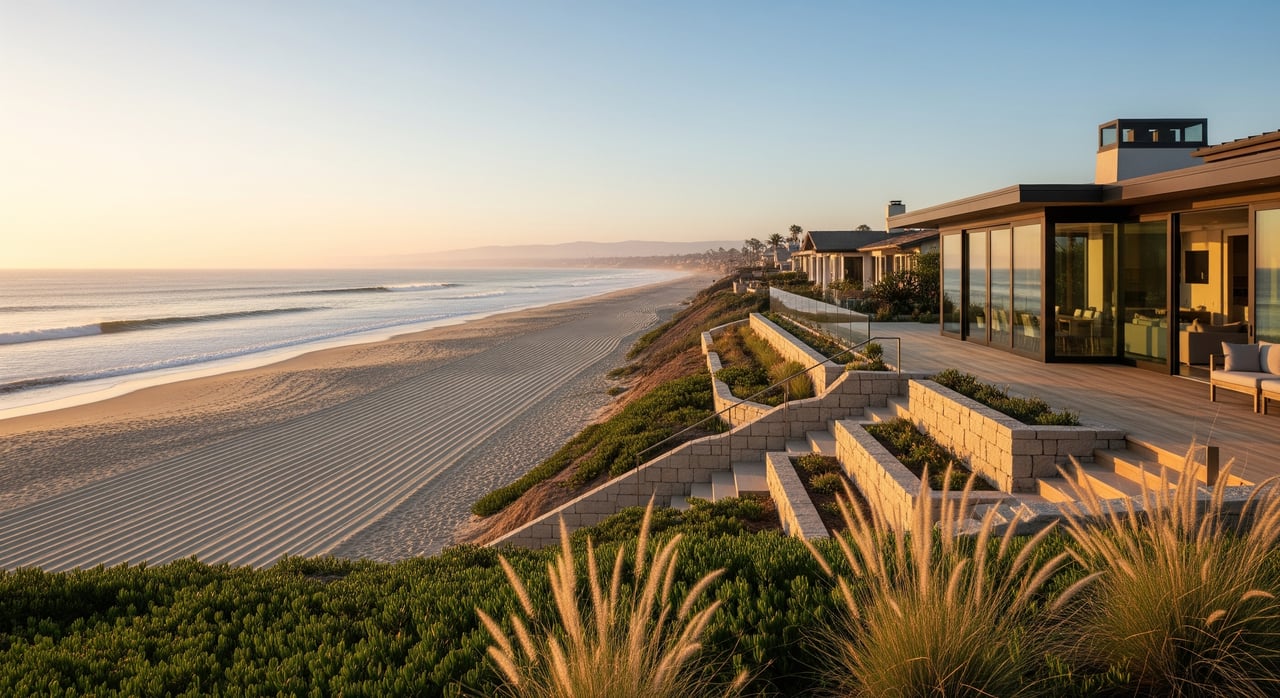
Cardiff Coastal Resilience: Market Outlook for Bluffside Homes
October 16, 2025
October 16, 2025
Did you notice Cardiff’s beach looking wider this year? If you’re weighing a sale or a purchase near the bluffs, it helps to know what recent sand projects and evolving bluff policy actually mean for property decisions. You’ll get a clear read on the near-term benefits, the long-term limits, and the due diligence steps that matter. Let’s dive in.
In late 2021, about 63,000 cubic yards of sand dredged from San Elijo Lagoon were placed on Cardiff State Beach to improve beach width and resilience. You also saw a major federal effort in 2023 to 2024, when the U.S. Army Corps of Engineers added roughly 340,000 cubic yards along Encinitas beaches and 700,000 cubic yards in Solana Beach, with completion celebrated in May 2024. The goal is a protective berm that reduces direct wave attack on bluffs during storms. You can review the scope and schedule on the USACE Solana-Encinitas Shoreline Study.
These placements replaced cobble in spots and widened the usable beach in many areas. Local reporting noted gains on the order of tens of feet, with about 50 feet in some Encinitas reaches after the 2024 work. During construction, crews staged equipment and ran temporary pipelines that affected beach access in sections. That kind of short-term impact is typical, as noted by nearby cities during past efforts, and is worth disclosing in a sale. For background on municipal sand efforts, see SANDAG’s beach replenishment overview and local reporting from Axios on Encinitas beach width.
Two Coastal Act policies guide decisions at the shoreline. Section 30235 allows shoreline armoring to protect existing structures or beaches in danger from erosion, but requires mitigation for impacts to sand supply. Section 30253 directs new development to avoid needing future shoreline protection. You can explore these policies in the Coastal Commission’s sea level rise materials on the Coastal Commission climate and SLR page.
Encinitas uses its Local Coastal Program to encourage sand nourishment and other soft shoreline strategies. The city also manages nature-based projects, like the Cardiff State Beach Living Shoreline, that restore dune function and help dissipate wave energy. Learn more on Encinitas’ Coastal Zone Management page and the Cardiff Living Shoreline project.
Large fills are coordinated by the USACE alongside state, regional, and city partners. Private or smaller protective measures typically require a Coastal Development Permit, with reviews against local and state policy. Given the long-term beach impacts of hard structures, approvals for armoring face strong scrutiny.
Sand fills are designed to absorb wave energy and reduce bluff toe undercutting during storms. Sand naturally moves with waves and currents, so project benefits fade without periodic renourishment. The Encinitas federal segment anticipates follow-up placements roughly every five years over a 50-year horizon, subject to funding and conditions. You can confirm timing and intent on the USACE project page.
Compatibility counts. Projects seek sand that matches local grain size to avoid rapid loss and ecological impacts. The 2021 Cardiff work used material dredged from San Elijo Lagoon, as summarized in SANDAG’s replenishment program.
You should expect wider beaches and improved recreation in many Cardiff and Encinitas stretches following the 2024 work. A wider berm provides a modest buffer to reduce direct wave attack on bluffs during typical storms. This is a notable plus for day-to-day access while scheduled renourishments continue. Local reports captured the visible width increase after placement.
Expect temporary staging areas, fenced zones, and pipelines when sand is being placed. Beach access points, parking, or stairs can be affected for periods. If you are selling, it’s smart to disclose recent or ongoing work that influenced access or use. Nearby municipalities describe these typical impacts in their sand information, such as the City of Solana Beach’s beach sand page.
Nourishment is maintenance, not a permanent guarantee, and depends on multi-year public funding cycles. Hard armoring remains heavily regulated and is generally limited to protecting existing development at risk, often with required mitigation and time limits. Insurance, financing, and resale can be influenced by coastal hazard history and disclosures. Encinitas posts safety guidance and closures related to bluff failures on its bluff information page.
Recent sand work widened parts of the beach and offers a helpful buffer in the near term. Over the long run, Cardiff’s shoreline will continue to be managed through periodic renourishment and a policy preference for softer, nature-based solutions. If you plan to buy or sell near the bluffs, focus on permits, disclosures, and future project schedules so you can set realistic expectations and protect value.
Ready to interpret these signals for your specific address and timeline? Reach out to Katie Nelson for local guidance and a step-by-step plan.
Stay up to date on the latest real estate trends.
Katie’s award-winning experience and long-standing ties within the community provide her clients with a distinct advantage when it comes to finding their dream home or investment opportunity.

KATIE NELSON | CA DRE# 02134845
ADDRESS 682 S Coast Hwy 101 Suite 110 B Encinitas, CA 92024